Wednesday, March 24, 2010

Mountain Dreams

30 July 2003, Maropea Forks - solo and my 43rd birthday.

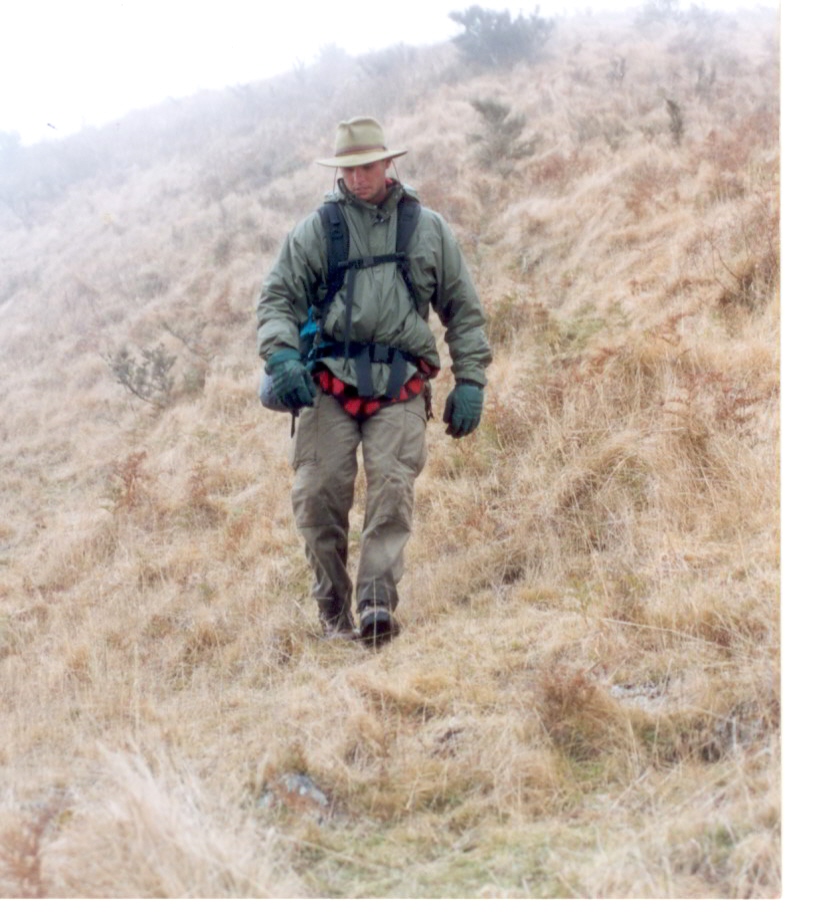
I will settle upon this photo as my own personal favourite of myself in terms of the Ruahine. I was 43, certainly not a young man, but I was fit, there were no physical barriers holding me back.

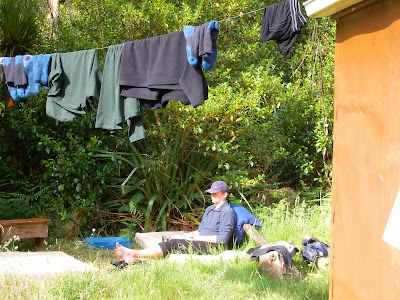
A solo birthday celebration, a venture into solitude and a place I love in the middle of winter. No easy feat in the grasp of a long walk down an ice cold mountain river. Shit! It was cold. To arrive at this beautiful place, cold, wondering, exhilarated. To build a little fire in that wonderful stove just for me, but yet for everyone, was a distinct pleasure and honour, and very warming in all ways. The next day I just stayed put as the water I put in the billies inside the hut had a coat of ice upon them! Quite content I got the fire going just quietly and decided I would stay here another day. What I really love about this photo is not me, or the fully loaded already burning wood stove, but that kindling bucket in back of me , which states 28 Litres of Golden-Syrup. which is a lot of syrup, of any kind. It harkens us back to days long gone, days of yore. When people knew spots like this other than just once, other than just passing thru.


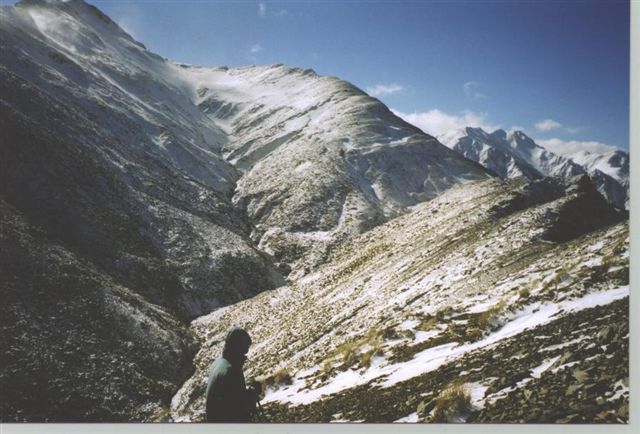
Snow fall at Maropea Forks. Such a magnificent moment!


Back yard at Maropea Forks.


John and Jeff, meeting for the first time at the beautiful waterfall about 30 minutes from Maropea Forks. A somewhat out of focus photo, but one I have come to love. Jeff, a great mate visiting from America, and I had walked in via Sunrise to Top Maropea the prior day, spent the night in that lovely spot, and then carried on late the next morning leisurely paced both due to my hip, but even more to the fact it was just such an incredible place to have such a fine reunion with one of my oldest friends. After all what's the hurry? John started early that morning from his car and caught up to us just a few moments before the photo above unfolded. We then spent the next three days in this amazing area, walking the rivers and ridges to the tops, Jeff doing a bit of trout hunting (successfully), and a lot of just lazing about doing not much at all. This area is my goal for returning to the mountains in July for my 50th birthday.


Maropea Forks in August. Another winter birthday celebration with a fine friend and brother, Gustav.

27 August 2007 Maropea Forks hut:

I shall always remember the exhilaration of standing outside the hut by the river under a full moon. After an afternoon when on a walk up river a huge snowstorm blew in, wild and furious, and I rushed back to the hut where Gustav had the fire stoked up and we stood out on the porch watching the trees sway and dance, the wind rushing and howling, building to loud crescendos, the snow swirling all around. Then it settled into a gentle snowfall, something like out of the movie "It's a Wonderful Life", where Jimmy Stewart runs about the town joyfully after discovering his own worth. I'm with ya Jimmy! And now the fresh snow covers all, the only man made footsteps to be seen for miles are ours! The entire scene is translucent, the snow has been lit into life by the light of this full moon. The water fall of the stream across the river unfurls in a cascade of glowing shimmering satin, the tall trees on the surrounding high ridges reveal their true character as the snow brings their souls to life in ways we have never before seen. The faces tell us their stories, each individual tree speaks to us. Some tell of laughter, many shed tears, and even seem to howl in despair of what will become of this scene. We are here for this brief second, but for just these few moments we have connected with the Timeless.


Moments like ones above are what I miss most right now, and thoughts of being amongst these mountains overwhelm me as I write these words. To know what roaming amongst them means to me, and to be unable to do so, cripples more within me than the physical pain of this hip will ever do. So roaming amongst them once again is my goal. To accomplish that I am having my hip replaced in a matter of days, then under taking my recovery, my rebuilding, and God Willing, my reunion with the Ruahine.
I am not sure when I will return here, how I will feel, the thoughts I will have. So I thank each and every one of you whom has made this under taking so special. I could write many words to so many people, but I will just write Kia ora for your time in coming here, for your time in your own special places, in your words and thoughts of encouragement, and support. For the aroha that I feel in my heart. Enjoy the Wild Places! Till I return with a tale of the mountains! Roam the wilderness and may the mountain breeze blow gently upon you. Don't Look Down. Kia kaha!

Aroha,
Robb

Monday, March 15, 2010

"Surgical Mining"

"Gold Mining"


"Coal Mining"

"Mountaintop Removal Mining"


There does not appear to my eyes anything "surgical" about any of these types of mining. Indeed a search of mining technique websites does not reveal any reference at all to anything called "surgical mining". Yet it is fast becoming a media buzz word. Say it enough times and it becomes so. A phrase which rolls off our prime minister's tongue very smoothly, soothing the masses of any worries beyond tax cuts and g.s.t. rises. Yes, John Key has made it his own little Alfred E. Nueman catch phrase (What? Me Worry?). Don't buy it folks, it does not exist. If Key, Brownlee and National consider placing entire towns in peril from landslides and erosion caused floods due to gold mining hills in the Coromandel as acceptable collateral damage, then it should be of no surprise they also refuse to rule out the use of "other" types of "modern method" mining techniques. Modern method mining techniques are pictured above. All extremely brutal, all irrevocable scars upon the earth, our National Parks, our Wild Places. Mountain top removal is possibly the worst demonstration of man's disdain for the earth. It involves simply cutting away all the forest surrounding the victim, then dynamiting as much as 500 down into the mountain to get at the coal, or whatever might be down there, and dumping the removed earth into the surrounding valleys, choking and killing any water ways. This is one of the "newer" mining techniques. There doesn't seem to be anything in there relating to "surgical".


Polluted and ruined stream from mining extraction


A mine drainage tailing pipe.


The Coromandel Peninsula is under heavy attack, one of the areas targeted being the Parakawai Geological Reserve, a mere 70 hectare area coveted by the gold diggers, but also a treasure trove of native species of frogs, kokopu, insects, and native bird species. Within this area the volcanic landscape encloses indigenous forest and one of the last remaining water catchments in the Coromandel running from forest to sea. In New Zealand gold mining commonly results in 3 grams of gold per 1400 kilograms of rock dug up. I hardly think that will involve any "surgical" precision mining techniques. They will destroy it all.

I have been to Parakawai twice. In 1994 I picked up my friend Gustav in Auckland and we drove to the Coromandel, exhilarated by the sea at Waihi Beach then driving to a place my mate Nigel had provided a map to outside Whangamata. We shouldered our packs and headed to a campsite Nigel had described to me as beyond compare. We walked through the lush green and steamy forest climbing to a river we heard, then saw come into view and my heart leaped with joy. It was a stream below us with water so pure and clear it took my breath away. Above us we could hear the symphony of many different layers of water, and suddenly emerged out of the bush onto the stream to find ourselves looking at the beautiful depths of blues and greens under the pool of perhaps a 15 metre waterfall, and directly below us it fell in a series of perhaps another 4-5 significant pools and falls. It was ethereal. Gustav and I were absolutely speechless, yet the huge smiles upon our faces, and the lightness within our souls shouted the silent words of joy we did not need to speak. We set up a small camp on the opposite side of the main fall and spent the afternoon swimming in the depths of this wonderful paradise, climbing up the falls and exploring upstream, and finally getting up the nerve to jump off the cliff into the embrace of that lovely nectar below. We lit a small fire that evening and sat in the glow of it, our day, our friendships, and the comforting lullaby of this river on its way to the sea.

A few years later carrying a large pack I returned with Tara, who in in smaller carrier toted along little Taylor, then 1 0r 2. Once again we camped in solitude at this slice of heaven. I am told it has become a very popular local tramping spot and area in addition to its value as a heritage area.

To see this place destroyed, to think of that beautiful river with its graceful falls and elegant pools as a swill pit like pictured above, destroyed for GOLD! I feel the bile rise up in my throat.


The Makaroro in the Ruahine. A reminder of what this is really all about.


If our system has depleted itself, and the "time" has come to rip into the few wild and relatively pristine areas still left, perhaps we are really asking the wrong questions. These people are up to no good and must be confronted and stopped. Once again I present the words of Edward Abbey:
"The Rules will be dictated by the extractive industries - the coal, oil, and power companies. Not only do our state politicians fail to resist these alien forces, they bid against one another to invite them in. Our good old boys would sell their mother's graves if they could make a quick buck out of the deal; crooked as a dog's hind leg, tricky as a car dealer, greedy as a hog at the trough, these men will sell out the West to big industry as fast as they can, without the faintest stirrings of conscience. Governors, U.S. Senators, congressman, and our chamber of commerce presidents don't give a hoot about future losses; they figure, rightly, that they personally will all be dead by the time the future extent of the disaster becomes clear. So much for the canyonlands of Utah and Arizona: nothing but a barren wasteland, anyway, as any local Jaycee will tell you, nothing but sand and dust and heat and emptiness, red rock baking under the sun and hungry vultures soaring on the air. Quite so men, quite so: nothing but canyon and desert, mountain and mesa, all too good for the likes of us."
If we change a few nouns to those like New Zealand, prime ministers, mp's, mayors, councils, and businesses, and the desert and rock, to bush, rivers and mountains, and the year from the 1970's to the present once again we find the future upon us.

Kia kaha!

Saturday, March 6, 2010

BEWARE!!


To John Key, Gerry (Lard Ass) Brownlee, all our current National rationalists, right wing talk back radio hosts and disconnected listeners, and each and every government, corporate technocratic organization in the world, and anyone in favour of invading Wild Places still there. Your fate awaits! Piss off the lot of you!

Thursday, February 25, 2010

A Day in the Life....

Sitting just below the highest point in the Ruahine, Mangaweka, looking down into the head waters of the Kawhatau valley and the main Ruahine range beyond.


25 Feb. 2010

I am not sure which hurts more right now. This ever troubling and degenerating hip, now reducing me to the gait of a very old man, the prospects in my current condition of sitting there above with John in such a place as remote as being on the moon, the pain like loose ends of electric wires running through my groin and down my knee which any wrong movement ignites. So I try to put myself back in places like above, where my soul burst free and waves of amazement and euphoria washed through me and cleansed me of the grime and guilt accrued out here, where I walked free and easy and roamed with a smile instead of an ever increasing grimace. Though even in good times in the Ruahine I often grimaced!
Or I wonder perhaps instead if I feel even more this pain deep inside me as a result of the unrelenting attack upon our wild places by our own government, and how in the eyes of so many it seems to make it right. These past few weeks when I have been really focused on trying to, from a grass roots approach, engage people I met through out my day, family, friends, in how they felt about the actions of our government attacking our wilderness. And to find most are either in favour of getting any economic benefit to be had from places they have never seen, or will see, or simply are not that concerned by something so far away from their lives. There are bigger fish to fry, our jobs, our mortgages, the economy, that we have all been sold the rubbish old Ed predicted. The pain of that cripples me as much as this hip.


The view from directly across the other side of the photo above, looking back at the Hikurangis and Mangaweka.
I have never claimed to be clever. I am not a highly achieved academic, I do not have a huge grasp of economic facts and figures, and I have little response to offer witty and self serving ripostes on media reporting and the ever growing world of the internet and political spectrum aligned blogs, particularly on the right. That is all beyond me, I have little knowledge of anyone even being here aside from comments left. Mostly what I do here is for me. To look upon these ranges I adore when I cannot physically be there, is pretty cool for me. And sad at the same time. My son Charlie the other night had me type Maropea Forks onto You Tube. What came up was a group of helicoptered in hunters in the roar of 2009. Most of the pictures were from inside the hut with the inhabitants in various stages of inebriation, the defining photo one of the hunters gathered on the porch when first dropped off with a person high stack of their trays of beer the focal point. It is not just from the government these places need protection. Helicopters!


A Ruahine water fall.

My point being I do not care about economics, about the political spectrum and clever posts and responses defending a political view, or even trying to convince those of disconnection to connection. What I care about are the Wild Places. And that is that.

Bugger the statistics about our economic future, and the shit about our human right to dominate the Earth. Even here I preach to the converted, convince myself more of what I already know. Out there with the aims of our own elected government, the absorbed words of the media, talk back radio, entrenched disconnection, and conversations in the tea room lie the real bastion of our demise.

A common quote that people refer to of Edward Abbey is "Wilderness needs no defense, only defenders", or there abouts, always rung somewhat to me as the first quote that came up on Wikipedia and sounded good. I always thought it a bit over done. Until now, when I feel it my gut and my trembling fingers.


John next to a Spaniard, a native plant with razor sharp needles and leaves and not to be trifled with. This was the first encounter we had with them at river level as normally we found them up high, mixed in with the leatherwood as another delightful treat on steep climbs.


A camp on the Waikamaka river after along day, a lot of rain and a flooded gorge. Eventually the rain stopped and the rivers and streams dropped as quickly as they rose, but a gorge just up from here stopped us. The water level was over our head and climbing over not a good option. We retreated to here, and it proved an excellent decision and a great spot.


John, the next morning in the crux of the gorge where the prior evening the water was at the top of the rock on the right. Hence the retreat to our river camp after a 10 hour plus day.


Above Rangi saddle on the way to Waterfall hut. We took a wrong route and did a seriously steep climb high above the saddle, only to discover it actually was far below us. The view across the valley made it a worthwhile mistake.


Waterfall hut


Aw shit, if you don't get it you don't get it. If these places and just the knowledge of them being there does not move you, then nothing here will. I can't come up with any clever arguments to change minds and sway people over from the Cement Jungle. It seems too entrenched, too set, and the disconnection from anything wild too complete. If we have already compromised 87% of our land and now need to attack the remaining 13% to get at it's "real" value it would seem to suggest that something is inherently wrong with the system. Yet the machine grinds on.


I believe in Nature in Wild Places, in the the Earth. If that does not suit so be it. Sides are being chosen and this is mine.


Dedicated to my Wild Sister Robin, "Naked in Eden".


Even in the midst of summer, a dive into the chilly embrace of the mountain river is a jolting experience. To have done it and then stand there tingling and refreshed as the mountain breeze evaporates the dripping pure water, is a reminder we are alive. Those of us whom have done it in winter are simply Polar Bears - hopefully with a hut nearby and the fire blazing!


Not many options here!


Shingle sliding is always an interesting way down. Very quick, but one wants to make sure the bottom terminates cleanly and not in large bluffs which would not be pleasant at speed.


"All very well, the reader thinks, for a few thousand farmers and ranchers who want to save their homes and livelihoods, to preserve a charming but no doubt outmoded way of life. And wouldn't it be nice if we could keep the air pure, the wide open spaces, the canyons, rivers, and mountains free from pollution from a rash of new power plants. But America needs the energy. Our political and industrial leaders assure us that the very survival of America as a great world power may be at stake. We cannot let our future be dictated by a cartel of Arab potentates. We have more coal than the Arabs have oil. Let's dig it! The assumption is that we must continue down the road of never ending economic expansion, toward an ever grosser gross national product, driven by the mania for Growth with a capital G that entails, among other things, a doubling of the nations energy production every ten years. "Expand or expire" is the essence of this attitude, exemplified in the words of President Ford in a statement to an Expo' 74 audience:

"Man is not built to vegetate or stagnate - we like to progress - zero growth environmental policies fly in the face of human nature." But a child can percieve that on our finite planet there must be, sooner or later, a limit to quantitative growth. Any high school math student can prove that if our production of electricity continued to grow at an expotential rate of 100 percent every 10 years the result would be, in less than a century, a United States of America in which every square foot of land surface was preempted by mines and power plants, leaving no room at all for homes, cities, farms, living space, or even grave yards. Growth for the sake of growth is the ideology of the cancer cell." - Edward Abbey , essay on The Second Rape of the West, cited from The Journey Home.


Shit Ed, we haven't come too far from 1974. In our modern age of sound byte living 1974 is like the stone age and few might give your words the modern credence they deserve, and yet are so fortelling. 35 years is not even a passing of gas in terms of Nature's time. Yet so many of us seem to grasp onto our brief time here as the be all and end all. Sometimes I think I am the more religious of all my God Fearing friends. Everytime I have been in the mountains, or even dream about them now, I am in Church.


The near end of a perfect day shared above. RTC Summer Tour day 3 from a camp on the Waikamaka river to Waterfall hut. A day of sun, cloud, rain, of rivers, streams, and high climbs with huge views of these mountains. Of friendship, route finding and a an empty hut in the mountains which we made our home for the next few days, as many other kindred spirits have. Days like this are why we need these places. Kia kaha!

Aroha,
Robb

Thursday, February 11, 2010

Whata ngarongaro he tangata, toitu hewhenua : Man disappears but the land remains.


Most times in life the things we most worry and fear over do not come to pass. This is one of the greatest self lessons I have learned in the mountains. Yet sometimes that fear and worry does appear, does manifest itself in real and terrible ways. I have alluded to in a few prior posts about my concern for the welfare of the Wild Places of Aotearoa, that they were under the eye of individuals, corporations, share holders, and those whom would alter them eagerly for the benefit of man. That has come to pass. Our National elected government has now clearly stated their intention to open up our publicly held conservation estate to mining and mineral "extraction". The battle is truly upon us, sides will be taken, and the future of the Land, and our children is at stake.


The Conservation Estate of New Zealand compromises 13% of our land mass. Within it lies the beauty and immense treasure of such gems as Aoraki, Aspiring, Arthur's Pass, Fiordland, Taranaki, the mysterious Urewera, Tasman, Nelson Lakes, Westland, Tongariro, and the newest and perhaps most susceptible, Kahurangi. There are , of course, other jewels at risk, such as my beloved Ruahine amongst other lesser known places. The contempt our government shows for any wild place makes these even more at risk should anything of "value" turn up. I use words like treasure, gems, and jewels, in the sense of the wealth they contain in their wildness, in their ability to connect to parts deep within us we seem to be losing even faster than I ever imagined. The wealth they represent in their Wildness is too much to ever comprehend or put at risk. Too many others see treasure, gem and jewel, as simply representing potential wealth in terms of money. And so these places become mere grid lines on charts and maps representing dollar signs. 13%!!! Is it too much to ask to just leave that much alone? To just let it be and let it represent what it can be to those whom chose to seek it, or even just dream of seeking it? To leave our children, and their children, just 13% of Wilderness! How they will hate us!


Our smiling and very rich prime minister, John Key, uses buzz phrases even better than his jowly servant Gerry Brownlee. Soothing utterances such as "sensitive extraction", "all New Zealanders care about conservation", lie next to the dark possibilities of "economic growth", "job creation", and bringing "wealth" to all New Zealanders. A very quick check on companies mining or hoping to mine, within Aotearoa will tell one 4 primary movers in this travesty have little connection here aside from its interest in our "wealth". As soon as the "wealth" is extracted they will leave the mess behind for our future generations to contend with. "Clean and Green New Zealand", "100% Pure New Zealand". It is the Big Lie my friends. We have already desecrated the areas outside the 13% left pure, now the time has come to move in on that as well. It makes me weep.


Edward Abbey has always been an inspiration to me. Though later in his life Ed wrote what I considered some far out offerings about the governments NOT wanting people to HAVE access to wild places, real wild places. A paved road leading to a look out some where would suffice the urge for us once the connections are truly severed. I used to think Ed might have had a few too many drams by then, he was indeed a heavy booze hound by that stage, and that there was no great conspiracy, that deep down governments are here for US.
Ed, I apologize, you always were ahead of your time, and the future is upon us. They really do want us to just care about our mortgage, our job, fitting in like everyone else, and just being a good citizen and not asking too many questions. Total Disconnection. Holy Shit!

Earth First! Kia kaha! Please, Let us fight these Bastards where we stand. We stand on the Earth.

Aroha,
Robb

Friday, January 22, 2010

Dreams


I have been having these strange dreams about the Ruahine as of late. The common theme seems to be walking amongst all the beauty and grace of the mountains, and most often with those whom I have been there with. We arrive at some far off destination and find loads people there, all sorts of noise and a confusing jumble of scrambling to find room. Last night it was just walking to Sunrise hut to find a road, cars and a petrol station up there! I wake up sweaty and filled with dread, then realize where I am. Separation anxiety perhaps? I hope so, but every day I keep waiting for this National government to show its true hand in regards to our wild places, and that combined with my own inability to Be There is leading to some very restless nights.


So it has been a real place of refuge to come here and peruse my library of experiences and recall the serenity and solitude such places still offer. The memories and sensations for instance of drinking from a mountain tarn high on the golden tussock tops of the main range as in the first photo. After a steep and sweaty climb up from Upper Makaroro valley to the tops these tarns are a welcome and beautiful sight, not to mention slaking a mighty thirst with the cold clear water. There are now signs at most of the huts which have water tanks warning of the risks of drinking untreated water, and there are those who will not drink from the streams, rivers, and tarns. I myself have never hesitated in my 17 years to simply slake my thirst in the handiest source nearby, and I recall a few times being extremely hot and thirsty with no water. A time with Nigel on a hot and steamy day on the Apiti track above Leon Kingvig hut. When we finally got down to the hut I literally staggered into the river and tried to drink it all. Or with Taylor and Jake on Parks Peak ridge, pictured above across from the tarn. It was a blazing hot summer day, and with two 9 year old boys on a long and undulating ridge we quickly ran out of water, resorting to squeezing drops of muddy moisture out of handfuls of moss. When we got to the old Parks Peak hut the sweet coolness of the nectar in that old tank was heaven. Those boys learned the real meaning of thirst that day - and I learned a bit more about tramping with young boys. Or the very first Ruahine tramp I ever did with Nigel and John in 1993. We climbed the dauntingly steep Gold Crown ridge, and on another hot summer day ran out of water long before we reached the car. I remember John and I standing on the ridge on the way down, far below us a shimmering ribbon of a waterfall which we could not reach. Fortunately we had left in the car a chilly bin, covered in ice and a six pack of beer. A cold beer never tasted quite so good as those, the best I ever had.


The old Parks Peak hut, and said water tank. In winter most often the tank was froze, and it is not an easy walk to get to, the area boggy and damp, yet it is place that I have been drawn to since my first visit there in 1997. I just stare as this photo evolves before my eyes, at the sights, sounds, the views of yonder, and moreso the amazing world of mosses, lichens, plants, tussocks, leatherwood, and twisted, gnarled and hearty mountain beech. This is the place perhaps more than any in these mountains which taught me to just slow down, to appreciate more my immediate world, all my being here in these few seconds, and really have a look around. You could be there forever and never see Everything. A place to just wander out to some point on the ridge and bash through a bit of forest, and find a place to just sit very still, Listen and Just Be. It is the most marvelous music ever. I will return here as soon as I can bear the 6 hour plus journey up this beautiful and yet arduous ridge.


Beauty is often in the eye of the beholder, and the Ruahine contains some 60 plus structures which could be called huts. I have been to 45 or so, some of my favourite spots numerous times, others only once. Above is Sparrowhawk bivouac - not a true hut in the sense the original structure was the back tiny portion. Really an emergency shelter placed just below the main range, and meant as a place to drop to when things are out of control, or getting close. There is enough room in that part for two sleeping bags, two bodies, a wee bit of gear, and that is it, and if you happened upon this place in such conditions you would consider yourself fortunate. The fact the front alcove has been added makes it a real bonus, it has a bench and a shelf to which to cook upon, and there are a few prime spots to pitch a tent if so desired. And the location itself is pretty sublime, high above the Makaroro valley and just a stones throw from the tops. Being situated in a little hollow gives it a unique almost micro climate out of the teeth of the nor'west gales common just above it. On this day John and I dropped down to it when the wind became too fierce up top and though our intention was to just have a cup of tea and lunch then carry on, the wind got even heavier and we decided to just stay the night. It was a fine afternoon and evening as we watched the clouds rip over safe in our little cocoon, and the next day, though still very windy and cold we carried onto Maropea Forks. I have never been back this way, but when I get my new hip I shall return. It calls out to me, an unreposing little gem.


An amazingly peaceful and calm early spring day at Lake Colenso. Nigel and I walked down into the basin containing the lake itself from Colenso hut, 20 minutes or above on a subsidiary branch of the Mangatera river. It is deep in the northern sector of the Ruahine, a reasonable walk from any direction, and a very unique and spiritual place. The Maori name for the lake is Kokopunui, as it was very productive source of kokopu, indigenous fish or trout, and there were apparently a few pa sites nearby established by local hapu for hunting, fishing, and gathering. With up to 150 metre cliffs surrounding the Kokopunui basin it is a wonderful view from high above it, a steep climb in and out of it, and a place of unique connection. I will return here as well. * My thanks to Kathy Ombler and her fine and often used guide - The Ruahine Forest Park. Still have my original copy from 1993!


The mighty stalwart beech - at some timeless moment to succumb to the irrestible flow and charms of the Pohangina river. Just above Ngamoko hut.

Aroha,
Robb

Thursday, December 31, 2009

A few more.... and Happy New Year!!


I have not been able to get out on my annual summer journey this year. I have attempted to twice but both times quickly realized the pain in my hip was too much to bear and I turned back. That is pretty hard for me to do. So I thought I would share a few more photos of my time in the mountains which will have to sustain me. Hopefully I will get a taste of the mountains next week on a short camping trip with Charlie. But until I get this hip fixed the Ruahines will have to live within me. It is just the way it is. I am not even sure what relevance I have here if the mountains are not the cornerstone of my words. I thank you all for your telling of similar situations and the improvement which resulted in so many lives, for your encouragement and thoughts from so far away. Believe me, I feel it. And in a positive sense I think of what that moment will be like when I once again hoist a load upon shoulders and head into the mountains on a deep journey, it makes my heart sing. Happy New Year to all, may the gentle mountain breeze be with you.

The above scene was from this year on the way to Iron Gate hut along the Oroua, it can be seen back in my post in July as well. Suffice to say the mountains were wet, the rivers and creeks raging, the skies grey and hanging low, and the forest dripping and vibrant. To the right water can be seen dripping off the trees. It is probably the best image I have personally been able to experience of a moment in a New Zealand forest on a rainy day, and being a tiny part of the myriad of colours, aromas, and sensations in such a place. John and I had each walked in on our own and I could only smile later on at the hut over a cup of tea with the rain beating down on the roof, as John described the exact same spot and showed me on his camera almost the exact same image. Communicating without words. Such moments I shall greatly miss.


Snow covered leatherwood and beech just outside Top Maropea. I had spent 4 days on my own at Maropea Forks, and returned back up river on a beautiful sunny day. By the time I got to the side creek which then climbs back up to here, a blizzard had rolled in. I climbed up to the saddle but knew if I tried to get across I would have died. It just oozed danger and forboding. So I returned to Top Maropea wet and cold and inside the hut the temperature was minus 7 Celsius. I had to get a fire going, and had no paper and little to work with, but by venturing into the blizzard I found some leatherwood and chunks of dead beech. I shaved off slivers into my billy and dried them over my stove, then breaking up pieces of kindling and larger chunks, and using a candle stub, worked my little fire into a great roaring beast, drying my wet gear, warming my soul - if not exactly the hut, and occupying my mind with a necessary task. It was a very cold night at Top Maropea, and the hut shook and rattled in the gales. Just as I was going to try and venture to the outdoor dunny I saw the roof of it blow by! The next day it was not until late afternoon that the wind died down long enough for me to cross the saddle, and even then portions of it on hands and knees. But it was all so beautiful.


Gustav and I high in the clouds after climbing from Otukota hut to the Mokai Patea. Basically the culmination of our first multiple day crossing of the ranges. A self portrait aided by the first marker we had seen after getting a bit wayward climbing over a huge slip above the hut and losing the track. We then bush bashed through thick, steep forest up to the open tops on a compass bearing and this was soon after we found the track. The Waikamaka valley cloud hidden below and the territory we had traversed in the background. A very cool moment.


My favourite photo of what a Ruahine hut day in summer can be like. John, outside of Otukota in summer 2008. A 5 day trip with low rivers, sunny skies, hot days, cool nights. All day long to do nothing at all. I imagine this was late afternoon after a day of swimming in the pure mountain water, and not too long before a wee dram just might appear.


A hot day, a mountain river, and men letting out the inner child. John in the Waikamaka river.


When will I see you again? Perhaps contemplating such very thoughts on the main range, a cold windy early winter day.


And finally, the place I shall most miss - the back yard at Top Maropea. The portrait painted a new and unique way on each visit. This particular experience a blend of the majestic purple and blue hues with the perfect dab of the golden tops caught in the fading sunlight. I just happened to turn around after tending to Charlie's Cairn and this sight just stunned me. How long I sat there for I have no idea. Until the last light faded I hope. Isn't it beautiful? Thank you for indulging me once again. Hope you have enjoyed.
Kia kaha!
Aroha,
Robb